Grid operators in the Netherlands, Germany, Poland and Spain now offer flexible connections: full power most hours, a lower limit when the grid is congested. We work out how much of that your site can safely sign, and with what battery. Then our controller runs each event to the end across the battery, cooling and any compute you allow, on top of the equipment you already have, and keeps an event record. Today it runs on a simulated site; pilots start with an assessment of your own data.
The problem
A data centre takes about two years to build. A firm grid connection in Europe's main hubs takes seven to ten. The grid isn't full all the time, though. It fills up on cold evenings and hot afternoons, and is fine the rest of the year.
So grid operators have started offering flexible connections: full power most of the time, less when the grid is congested. The catch is risk. Once you sign, you have to deliver every limited hour for years, sometimes for many hours or two days in a row, with a battery that also has to keep its backup reserve and recharge under the same limit.
Where there's room
We took 2025 hourly demand for 23 European countries and asked how much new data-centre load each national grid could take if that load stepped back in the busiest 0.5% of hours. Most of the room is in France, Germany, Italy and Spain.
Our own estimate, using Duke University's Rethinking Load Growth method on 2025 hourly demand (energy-charts.info / ENTSO-E data). It looks at whole national grids and ignores local bottlenecks, so treat it as the size of the opportunity, not a promise for any one site.
How it works
Usually a day ahead, for example 12 MW from 17:00 to 19:00. Sometimes with no notice at all.
It runs on site at the connection point and checks the meter every second. In our current design it works through the options in this order; each site's order and limits are agreed during the assessment:
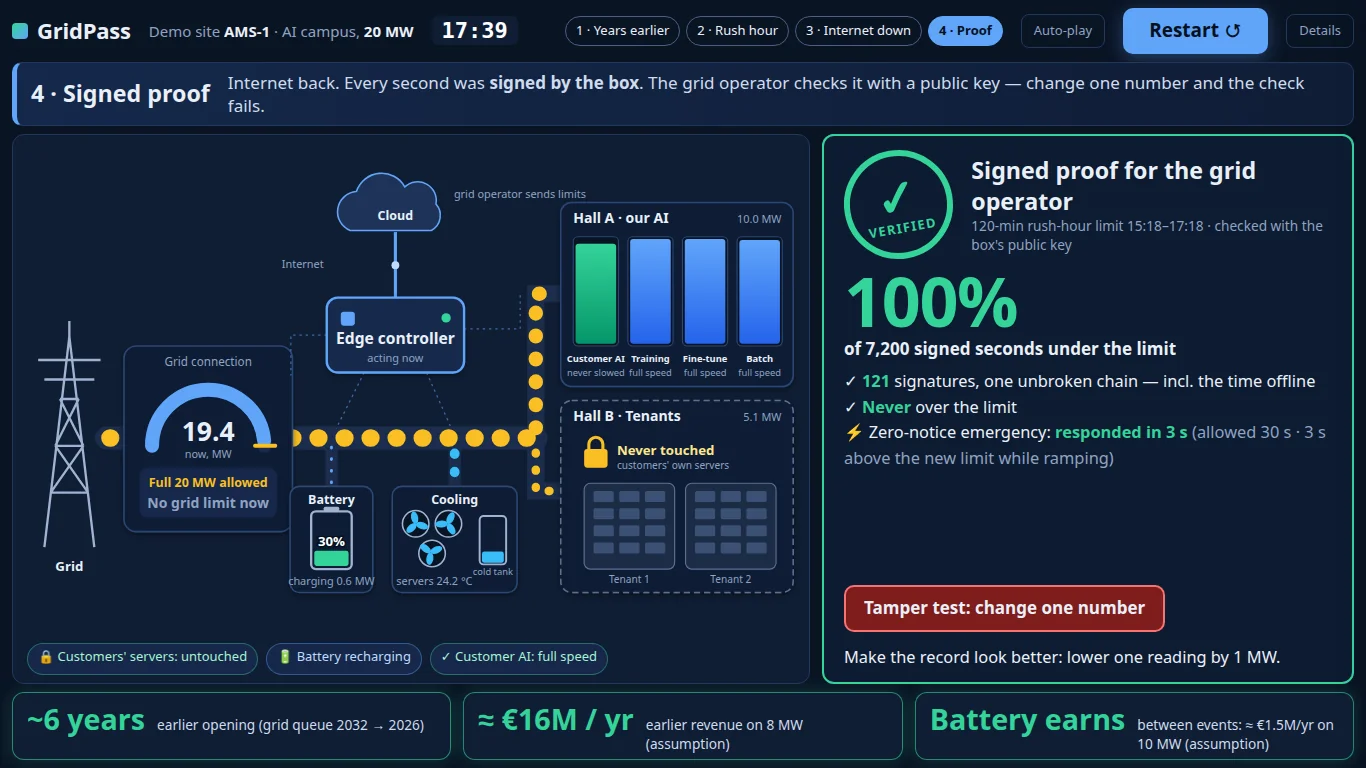
Each meter reading is signed and chained on the controller. The operator can check an event themselves using our public key. If anyone edits a single number, the check fails.
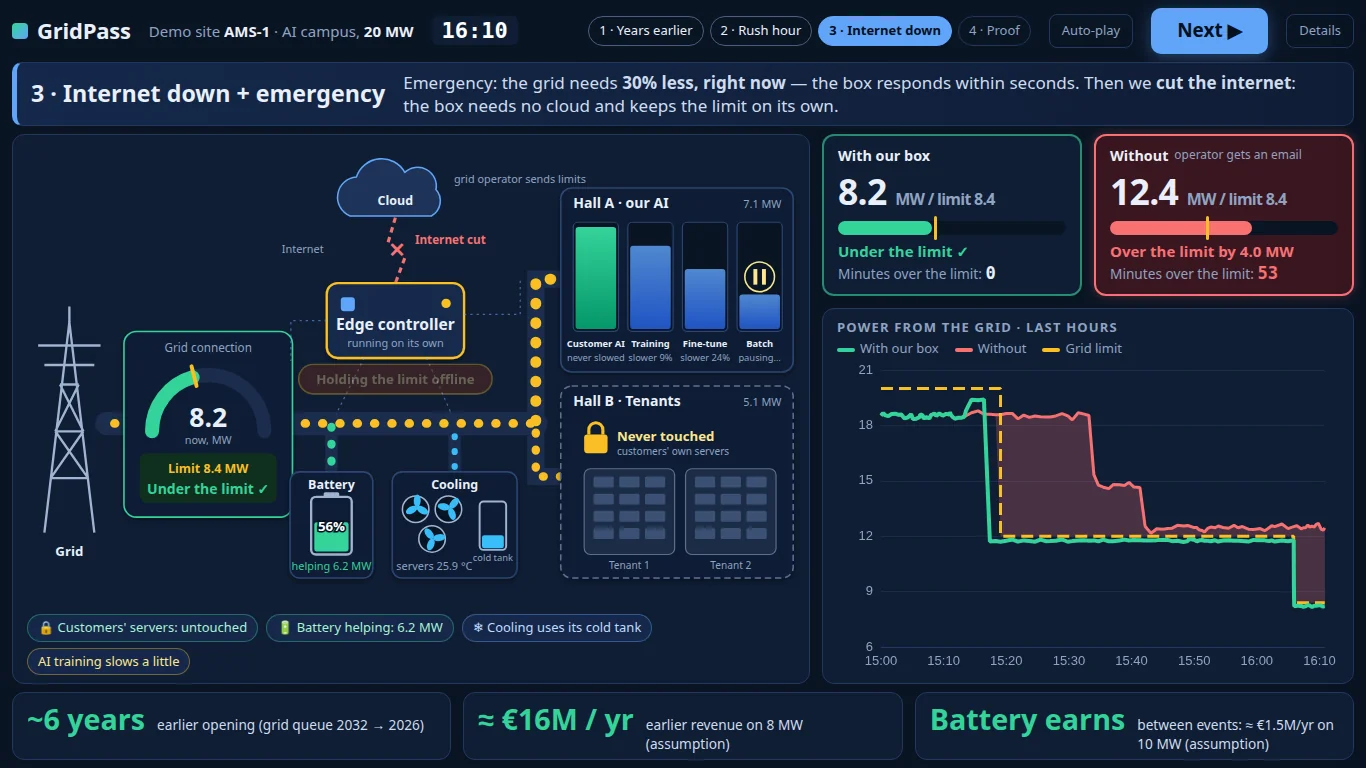
The controller sits at your grid connection, so it's designed not to need the cloud for a limit it has already accepted. While the link is down it keeps its signed readings on site and uploads them when the link is back.
Each reading is signed on the controller and linked to the one before it. The grid operator checks the chain with our public key. Change one number and the check fails at that reading.
How we differ
Software that slows GPUs works well when you own the GPUs. In a colocation building you usually don't. We work from the grid connection inward and use the battery and cooling first, so the site can stay under its limit without touching tenant hardware. Where GPU-level control is available, we use it as one more option.
Where we are today: working software, a live simulation, and our first field pilots in planning. We'll update this page as they run.
Who it's for
Open on the connection that's available now instead of waiting years for a firm one. For AI capacity we estimate each megawatt running a year earlier is worth about €2M in revenue. Your numbers will differ.
See how much of a flexible contract the battery and cooling can cover without touching tenant servers, and what it would take to cover the rest.
An event-by-event record from the site, alongside your own meter data. We want to learn what evidence you actually need; tell us.
Capacity in the regions you want, sooner. Inference isn't touched. Training may run a bit slower during congestion, within limits agreed in advance.
Demo
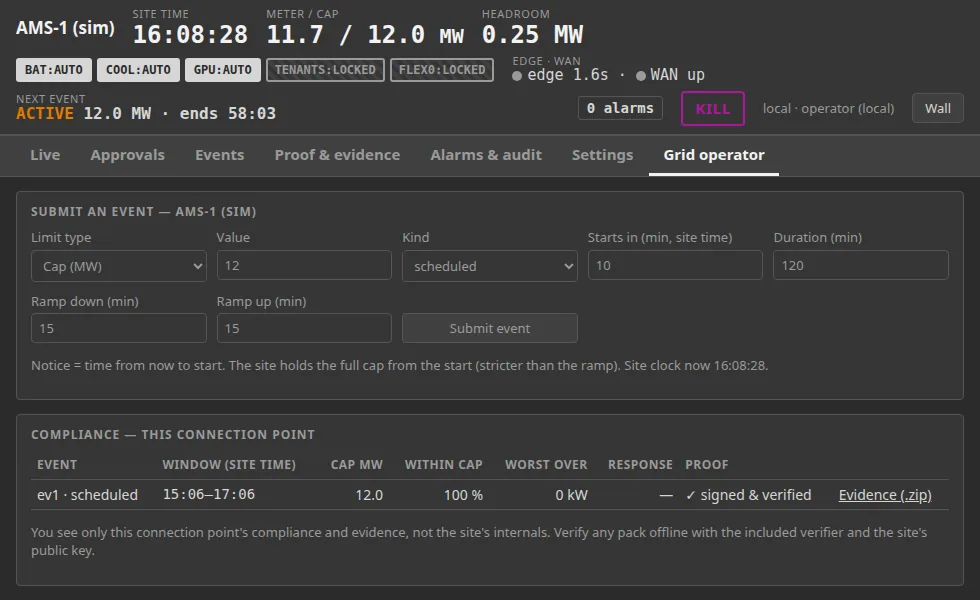
The demo is a simulated 20 MW AI data centre running against the same controller code we'll install on site. Press Next to send it a grid event, cut its internet connection and check the signed record. No sign-up needed. Everyone sees the same simulated site, so you may catch someone else's run in progress.
Connecting to the demo site…


Operator console
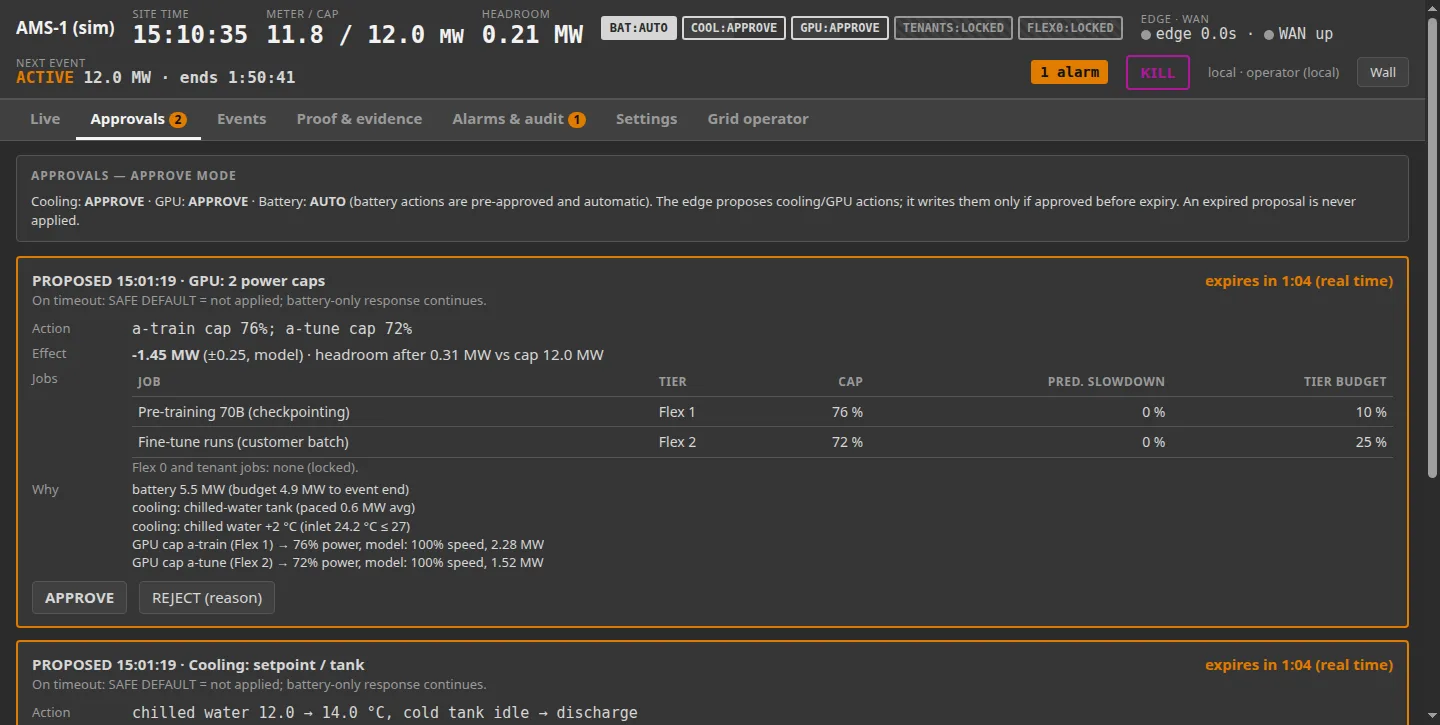
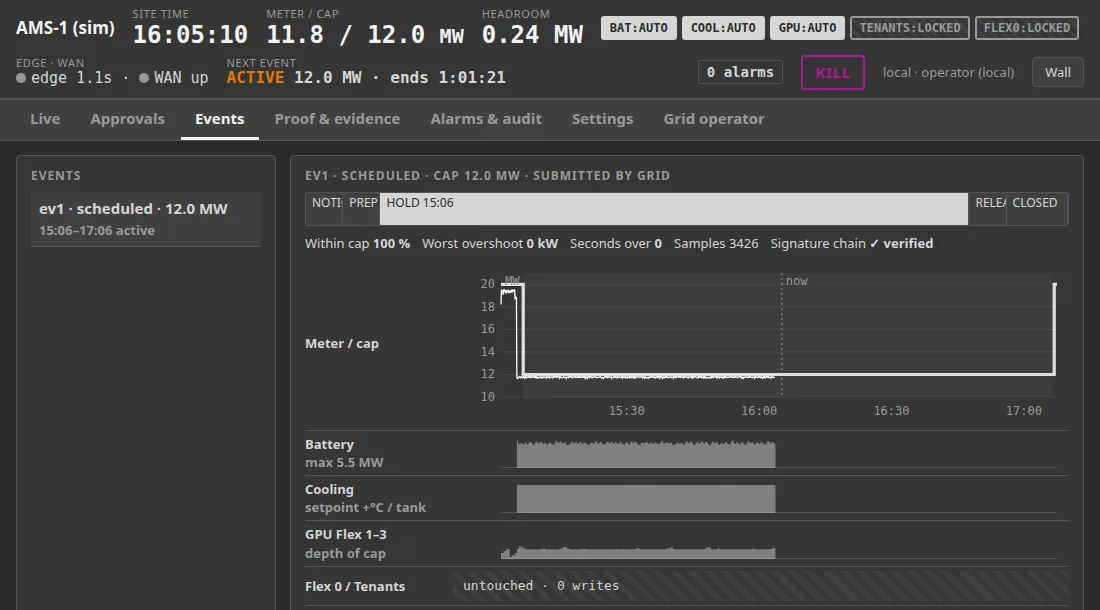
The console shows what the controller is doing and why. In supervised mode each action waits for someone on your team to approve it. The grid operator gets its own view with the compliance record and evidence for each event.


Pilot
About three to four months on one site. You decide when to move to the next phase.
We go through your load data and connection offer, and work out how much flexibility you need and what it would cost.
The controller is installed read-only. It shows what it would have done, and changes nothing.
Real grid events. Your operations team approves each action before it happens.
The controller handles events on its own, and the grid operator gets the signed record.
Contact
We're looking for a few pilot sites in Europe, and for grid operators willing to review how we record events. Tell us about your site, or email either of us directly.